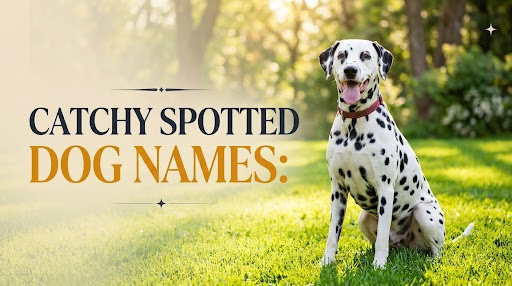
Bringing home a spotted puppy and stuck on what to call them? You’re not alone. Spotted breeds — Dalmatians, Australian Cattle Dogs, English Pointers, Great Danes, and Springer Spaniels — all share one thing: a coat that begs for a name as bold as their pattern. This guide gives you 200+ catchy spotted dog names, sorted by theme, gender, size, and personality, plus the naming mistakes to avoid.
Quick Answer: Best Catchy Spotted Dog Names
The best catchy spotted dog names play off pattern, color contrast, or pop culture. Top picks include Domino, Oreo, Patches, Pongo, Freckles, Speckles, Dice, Panda, Cookie, and Salt & Pepper. These names work because they’re short, easy to call across a yard, and instantly tie back to the dog’s unique coat.
Why Coat Pattern Matters When Naming a Spotted Dog
Every spotted breed has a slightly different pattern, and that pattern is often the fastest route to a name that fits. A Dalmatian’s dense black-on-white spotting reads very differently from the roan speckling on an Australian Cattle Dog or the liver-colored patches on a Springer Spaniel.
Before you land on a name, look closely at your puppy’s markings. Are the spots small and scattered, or large and blotchy? Is the base coat white, or is it merle, roan, or brindle underneath the spots? These details shape which names actually fit — a name like “Domino” suits crisp black-and-white spotting, while “Freckles” suits finer, scattered speckling.
Naming a dog after a visible trait also has a practical upside: it makes recall training more intuitive for kids and guests, since the name already connects to something they can see.
200+ Catchy Spotted Dog Names by Category
Classic Spotted Dog Names
These are the tried-and-true picks that show up on every top-100 list, and for good reason — they’re short, punchy, and instantly recognizable.
| Name | Best For | Meaning/Origin |
| Domino | Black & white spotting | Named after the game piece’s dot pattern |
| Patches | Any patchy coat | Descriptive nickname, works for any gender |
| Oreo | High-contrast black/white | Cookie brand reference |
| Pongo | Male Dalmatians | Lead character from 101 Dalmatians |
| Perdita | Female Dalmatians | Pongo’s mate in 101 Dalmatians |
| Freckles | Fine speckled coats | Descriptive, playful |
| Speckles | Roan or ticked coats | Sound-alike to “freckles” |
| Dice | Bold, symmetrical spots | Gaming reference |
| Dot | Minimalist spotted coats | Simple, direct |
| Splotch | Uneven, blotchy patterns | Onomatopoeic and fun |
Food-Inspired Spotted Dog Names
Food names are catchy because they’re familiar words people already say with warmth — and many describe color contrast perfectly.
- Oreo
- Cookie
- Pepper
- Salt
- Chex
- Biscuit
- Marble
- Brindle (technically a coat term, but works like a name)
- Chai
- Cocoa Puff
- Peppercorn
- Cobbler
Pop Culture & Movie-Inspired Names
If your spotted pup reminds you of a famous fictional dog, lean into it — these names carry instant recognition.
| Name | Source | Notes |
| Pongo | 101 Dalmatians | Classic male Dalmatian name |
| Perdita | 101 Dalmatians | Classic female Dalmatian name |
| Lucky | 101 Dalmatians | One of the puppies |
| Rolly | 101 Dalmatians | Chubby puppy character |
| Patch | 101 Dalmatians | Main puppy protagonist |
| Bolt | Bolt (2008) | Energetic, adventurous dogs |
| Sergeant Tibbs | 101 Dalmatians | Quirky, distinguished names |
Nature and Animal-Print Inspired Names
Spotted coats naturally echo patterns found in wildlife, which makes nature names a strong semantic fit.
- Cheetah
- Leopard
- Jaguar
- Fawn
- Birch
- Storm
- Comet
- Constellation (or “Stella” for short)
- Galaxy
- Meteor
- Starla
- Ash
Unique and Unisex Spotted Dog Names
For owners who want something less common but still descriptive, these unisex options work well for any spotted breed.
- Domino
- Marble
- Pixel
- Static
- Confetti
- Camo
- Rorschach
- Jigsaw
- Mosaic
- Blip
Short, Easy-to-Call Spotted Dog Names
Trainers often recommend one- or two-syllable names because they’re easier for a dog to recognize during recall. These combine brevity with a spotted-coat theme.
| Name | Syllables | Why It Works |
| Domino | 3 | Strong D-sound, easy to shout |
| Dot | 1 | Ultra-short, clear consonant |
| Chex | 1 | Sharp, distinct sound |
| Milo | 2 | Popular, warm-sounding |
| Duke | 1 | Classic, commanding |
| Ziggy | 2 | Playful, energetic |
Naming by Breed: What Fits Different Spotted Dogs
Not every “spotted dog” has the same pattern, so it helps to match the name style to the breed.
Dalmatians carry the most iconic spotted coat of any breed, with round black or liver spots over a pure white base. Names like Domino, Pongo, Perdita, and Patch lean into that heritage directly.
Australian Cattle Dogs (often called Blue Heelers or Red Heelers) have a roan or speckled coat rather than distinct round spots. Names like Speckles, Ash, Storm, or Blue tend to suit their finer ticking better than “Domino” would.
English Pointers and German Shorthaired Pointers often show liver, orange, or black patches combined with ticking. Names like Rusty, Patch, or Marble work well here.
Great Danes with harlequin or merle coloring have large, irregular black patches on white — closer in scale to a Dalmatian’s spotting, so bold names like Domino, Panda, or Jigsaw fit naturally.
Springer Spaniels typically show liver or black patches with feathered fur, giving them a softer look that pairs well with gentler names like Freckles, Biscuit, or Cocoa.
Naming Ideas by Personality Trait
A name doesn’t have to describe the coat at all — some owners prefer to match a name to temperament instead.
- Energetic/playful dogs: Ziggy, Bolt, Comet, Pepper
- Calm/gentle dogs: Dot, Biscuit, Fawn, Milo
- Bold/confident dogs: Duke, Storm, Panda, Jaguar
- Goofy/silly dogs: Splotch, Waffles, Confetti, Rolly
The Psychology Behind a Memorable Dog Name
Naming isn’t just a creative exercise — it has a practical side rooted in how dogs process sound. Dogs respond best to names with clear, sharp consonants because those sounds are easier to distinguish from background noise than soft, vowel-heavy words. This is one reason why so many top spotted dog names (Duke, Dot, Chex, Panda) share short, punchy structures.
There’s also a human side to this. A name that ties directly to something visible — like a coat pattern — gives everyone in the household an easy story to tell. “We called her Domino because of the spots down her back” is a memorable, shareable detail that a generic name like “Bella” doesn’t offer. That built-in story is part of why pattern-based names dominate spotted-breed naming lists year after year.
Trending Spotted Dog Names by Theme
Naming trends shift each year, but a few themes consistently perform well for spotted breeds specifically. Here’s a breakdown of the current standout categories and why they resonate with owners.
| Theme | Example Names | Why It Trends |
| Board game & tabletop | Domino, Dice, Checkers, Chess | Visual echo of spot patterns |
| Astronomy | Comet, Stella, Orion, Nova | Suggests scattered “stars” across the coat |
| Art & design | Pixel, Mosaic, Rorschach, Sketch | Appeals to owners who see the coat as art |
| Classic literature/film | Pongo, Perdita, Patch | Strong brand recognition, easy to explain |
| Minimalist/modern | Dot, Ash, Blue, Fawn | Short, trendy, works across breeds |
More Catchy Spotted Dog Names (By Length)
If syllable count and ease of calling matter most to you, use this list sorted by length as a quick reference.
One-syllable names: Dot, Chex, Duke, Blue, Ash, Fawn, Sprig, Chip, Speck, Fleck
Two-syllable names: Domino (short “Dom”), Milo, Ziggy, Rusty, Panda, Cocoa, Roxy, Cookie, Pepper, Marble
Three-plus-syllable names: Domino, Confetti, Rorschach, Sergeant Tibbs, Peppercorn, Constellation, Camouflage
Shorter names generally train faster, but a longer name isn’t a dealbreaker — many owners use a formal three-syllable name for the vet’s paperwork and a shortened version (“Con” for Confetti, “Rors” for Rorschach) for everyday use.
Comparing Naming Approaches: Descriptive vs. Character-Inspired vs. Random
Owners generally land on one of three broad naming strategies, and each has tradeoffs worth understanding before you commit.
Descriptive names (Domino, Speckles, Patches) directly reference the coat. The upside is that they’re intuitive and easy to explain to strangers at the park. The downside is that they can feel slightly generic since so many spotted dogs share them.
Character-inspired names (Pongo, Perdita, Bolt) borrow from movies, books, or games. These carry built-in personality and are fun conversation starters, but they can feel dated if the reference is tied to a specific era of pop culture.
Random or unrelated names (Milo, Duke, Roxy) skip the spotted-coat theme entirely and focus purely on sound and feel. This approach offers the most flexibility and avoids the “every Dalmatian is named Domino” problem, though it sacrifices some of the built-in story a pattern-based name provides.
There’s no universally “correct” strategy — the right choice depends on whether you want the name to say something about the coat, reference something you love, or simply sound good.
Common Mistakes When Naming a Spotted Dog
Choosing a name that’s too long. Multi-syllable names sound cute on paper but get shortened anyway during training and daily life — start with something short if recall matters to you.
Picking a name that sounds like a command. Names like “Sit,” “Kit,” or “No” (or anything that rhymes with common commands like “Beau” and “No”) can confuse a dog during obedience training.
Copying a breed cliché without checking fit. Not every spotted dog is a Dalmatian, so a name built entirely around round black spots may not match a roan or ticked coat.
Ignoring how the name sounds when shouted. Say the name out loud, at volume, across a yard or park. Soft names with lots of vowels (like “Aria”) don’t carry as well as sharp, consonant-heavy names (like “Duke” or “Chex”).
Naming based only on looks as a puppy. Puppy coats can change slightly as spots darken or fill in with age — a name based purely on current spot count may feel less accurate by adulthood.
Expert Tips for Choosing the Right Spotted Dog Name
Trainers and breeders generally agree on a few practical guidelines that make naming easier and training smoother:
- Keep it to one or two syllables for faster recognition during recall training.
- End the name on a strong consonant (like Duke, Chex, or Dot) — dogs pick up on sharp sounds more easily than soft, drawn-out vowels.
- Test it in real conditions by calling the name outside, at a distance, before finalizing it.
- Avoid names that rhyme with your other pets’ names or with common household words to prevent confusion.
- Involve the whole household in the decision so everyone uses the same name consistently from day one — inconsistent naming slows down training.
How to Test a Name Before You Commit
Even after narrowing down a shortlist, it’s worth running each candidate through a few quick tests before making it official.
Say it three times fast. If the name trips up your own tongue, it will be harder for your dog to recognize consistently over time.
Shout it from across a room. Names that sound fine at conversation volume sometimes lose clarity when called loudly outdoors — test this early, since recall training depends on it.
Check it against your household’s other names. Compare the new name to the names of other pets, family members, and even frequently used commands to rule out confusing overlaps.
Picture it on a vet form and a dog tag. A name that’s fun to say but awkward to spell can create small headaches down the road, from ID tags to microchip registration.
Live with it for 24–48 hours before finalizing. Many breeders recommend a short trial period, since a name that feels perfect on day one sometimes feels off once you’ve used it a few dozen times.
Registering a Formal Name vs. Everyday Call Name
If you plan to show your spotted dog or register it with a kennel club, it helps to understand the difference between a registered name and a call name early on.
A registered name is the longer, often more elaborate name used on official paperwork, pedigree records, and show entries — for example, “Riverbend’s Midnight Confetti.” These names frequently include a kennel or breeder prefix and are rarely used in daily life.
A call name is the short, practical version used at home, in training, and at the vet — in the example above, that might simply be “Confetti” or “Fetti.” Most owners choose the call name first and build a longer registered name around it later if needed, rather than working the other way around.
Male vs. Female Spotted Dog Names: A Quick Comparison
| Category | Popular Male Names | Popular Female Names |
| Classic | Pongo, Duke, Domino | Perdita, Dot, Marble |
| Food-inspired | Oreo, Biscuit, Chex | Cookie, Pepper, Cocoa |
| Nature-inspired | Storm, Comet, Ash | Fawn, Stella, Willow |
| Pop culture | Bolt, Patch, Rolly | Lucky (unisex), Roxy, Belle |
| Unique/unisex | Pixel, Static, Camo | Confetti, Mosaic, Ziggy |
Use Cases: Matching a Name to Your Dog’s Role
Family pets often do best with warm, food-inspired, or classic names like Oreo, Cookie, or Milo — names that feel approachable to kids and guests.
Working or herding dogs (common with Australian Cattle Dogs) often suit sharper, more functional names like Duke, Storm, or Blue, which carry well across open fields.
Show dogs frequently carry a formal registered name alongside a shorter “call name” — for example, a Dalmatian might be registered as “Sterling’s Midnight Confetti” but called “Dot” at home.
Rescue dogs who arrive already named sometimes benefit from keeping a similar-sounding replacement name (swapping “Spot” for “Dot,” for instance) so the transition is less disorienting.
People Also Ask: Spotted Dog Name Questions Answered
What is a good name for a Dalmatian puppy?
Domino, Pongo, Perdita, Patch, and Dot are consistently popular Dalmatian names because they echo the breed’s iconic black-and-white spotting and its ties to 101 Dalmatians. Short, consonant-heavy names also tend to work best for recall training.
What do you call a dog with spots?
A dog with spots is often simply called a “spotted dog,” though specific coat patterns have their own terms — Dalmatians have “solid spotting,” Australian Cattle Dogs have “roan” or “ticked” coats, and merle-patterned dogs (like some Great Danes) have irregular patchwork markings rather than round spots.
What is a unique name for a spotted dog?
Unique options include Pixel, Rorschach, Mosaic, Static, Confetti, and Jigsaw — names that reference the visual pattern of scattered spots without relying on the more common Dalmatian-themed choices like Domino or Patches.
Are Dalmatians born with spots?
No — Dalmatian puppies are born completely white and develop their first spots within about two to three weeks, with spotting continuing to fill in and darken through the first year of life.
What is a good nickname for a black and white spotted dog?
Oreo, Domino, Panda, Salt & Pepper, and Chex are popular nicknames for black-and-white spotted dogs because they directly reference the strong color contrast.
What are cute names for female spotted dogs?
Popular choices include Perdita, Dot, Marble, Cocoa, Ziggy, Confetti, and Stella — names that are short, easy to call, and pair well with a spotted or ticked coat.
What are strong or tough-sounding spotted dog names?
Duke, Storm, Jaguar, Blue, and Panda are common picks for owners who want a name that sounds confident rather than cute, often chosen for working breeds like Australian Cattle Dogs.
Can two spotted dogs in the same house have similar names?
It’s best to avoid similar-sounding names for two dogs in the same household, since overlapping sounds (like “Dot” and “Dolly”) can cause confusion during training and recall — pick names with distinct starting sounds instead.
What’s the most popular Dalmatian name from movies?
Pongo and Perdita remain the most recognized Dalmatian names from film, both originating from Disney’s 101 Dalmatians, alongside puppy names like Patch, Lucky, and Rolly.
Do spotted dog names need to reference the coat at all?
No — many owners choose names based purely on personality, favorite foods, or pop culture references instead of coat pattern; the coat-inspired approach is popular but not required for a great name.
A Brief Look at Where Spotted Coats Come From
Understanding the genetics behind a spotted coat can make naming feel more meaningful — and it’s genuinely interesting. In Dalmatians, spotting is controlled by a specific gene that suppresses pigment across most of the body while allowing it to break through in patches, which is why puppies are born white and develop spots as they mature. Larger, more defined spots and smaller, denser ones are both within the breed standard, which is part of why no two Dalmatians look exactly alike.
Australian Cattle Dogs get their speckled look from a different mechanism called “ticking,” where individual colored hairs are scattered through a lighter base coat rather than forming solid patches — this is why their pattern reads more like fine static than distinct spots.
Merle patterning, seen in some Great Danes, Australian Shepherds, and Catahoulas, works differently still: it dilutes patches of the base coat randomly, creating the marbled, irregular look often described as “harlequin” in Danes. Because merle genetics can also affect eye color and, in some cases, hearing or vision, responsible breeders test for it carefully — a detail worth knowing if you’re considering a merle-patterned puppy.
Knowing which mechanism produced your dog’s pattern can even help guide the name itself — a true Dalmatian with round, solid spots suits “Domino” far better than a ticked Cattle Dog, while a Cattle Dog’s fine static pattern is better matched by something like “Speckles” or “Ash.”
Final Thoughts:
The best spotted dog name is one you’ll happily call out a hundred times a day — at the park, in the yard, and during training sessions. Whether you lean toward a classic pick like Domino or Pongo, a food-inspired name like Oreo, or something entirely unique like Pixel, the goal is the same: a name that’s short, clear, and fits the personality behind those spots.
Take a moment to watch your puppy’s pattern, test a few names out loud, and get the whole family on board before you commit. Once you land on the right one, it’ll feel like it was always theirs.
